The all-season won nothing.
Edmunds put three sets of tyres on one Honda Civic and braked it on snow in Minnesota and on wet and dry surfaces in Arizona. Summer tyres won the dry and the wet. Winter tyres won the snow. The all-season — the tyre sold as the answer to all three — won none of them, and came last in the rain.
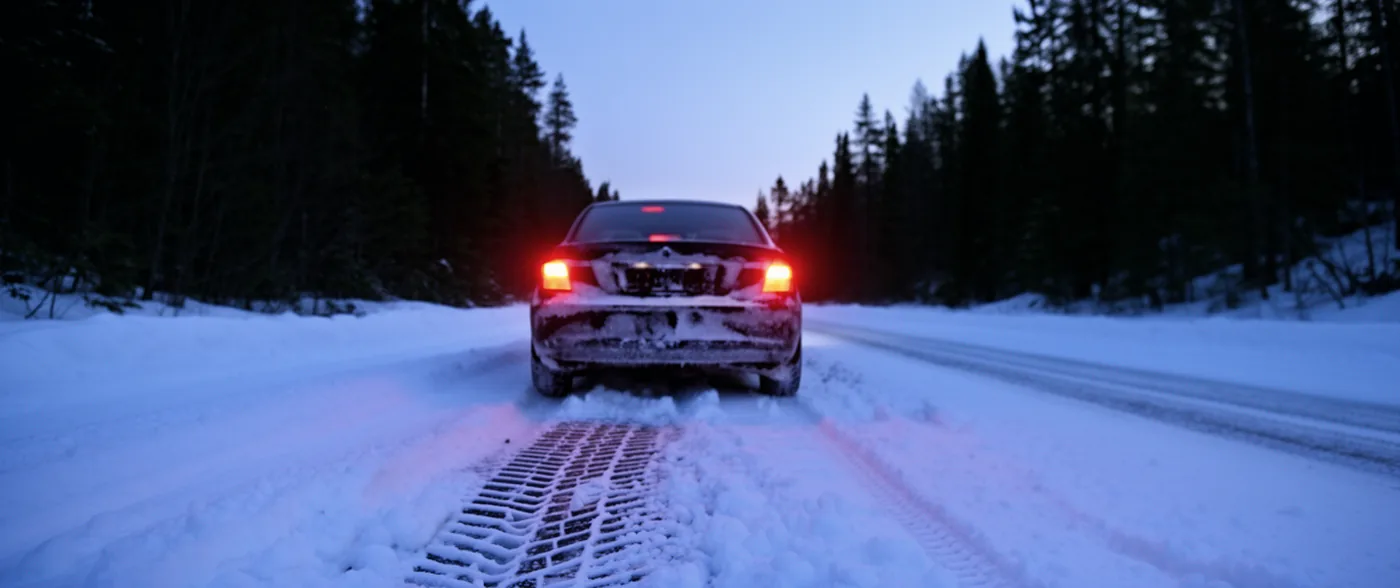
Three surfaces, one car, nine numbers
| Tyre | Dry60–0 mph | Wet60–0 mph | Snow40–0 mph |
|---|---|---|---|
| Summer | 120 ft 36.6 m | 157 ft 47.9 m | 351 ft 107.0 m |
| All-season | 131 ft 39.9 m | 215 ft 65.5 m | 184 ft 56.1 m |
| Winter | 155 ft 47.2 m | 181 ft 55.2 m | 156 ft 47.6 m |
Bold is the shortest stop in that column; the struck-through figure is the longest. Edmunds published feet; the Traffic Injury Research Foundation's review restates the same test in metres. All nine cells agree between the two to within a tenth of a metre, which is a firmer check than most figures on this site get.
The all-season won no column
Read the columns rather than the rows. Summer tyres take the dry and the wet. Winter tyres take the snow. Count the all-season’s wins and the answer is zero — and it is not merely middling, because in the wet it is 58 feet behind the summer tyre and 34 feet behind the winter tyre.
A winter tyre stopped shorter in the rain than an all-season did. That is the sentence worth carrying away, because it inverts what the category name promises. “All-season” describes when you may legally leave them on, not what they are best at in any season.
The honest reading is not that all-seasons are useless. They were second on snow and second in the dry, and one set on the car all year is a real convenience with a real price. The reading is that the convenience is the product, and the performance is what you traded for it.
Summer tyres on snow, and the test they could not finish
Scale runs to 351 ft, the highest measured value here.
use it Edmunds, Tire Test: All-Season vs. Snow vs. Summer, 2009. One car, a 2007 Honda Civic Si, on three sets of tyres across three surfaces: snow at a groomed facility in northern Minnesota, and wet and dry at the Arizona Proving Ground. Braking measured with ABS engaged, 40-0 mph on snow and 60-0 mph on wet and dry. THE AGE MATTERS: this predates the widespread arrival of three-peak-mountain-snowflake all-weather tyres, and all-season compounds have changed since, so treat the all-season column as a snapshot of its era rather than a description of a tyre you would buy today.
Summer tyres needed 2.25× the distance of winter tyres to stop from 40 mph on snow — 195 feet further, which is most of a football field.
At 60 mph the summer tyres could not be tested at all. Edmunds report that the available seven-tenths of a mile of snow was not enough room to accelerate and then stop, and estimate the stopping distance north of 800 feet. That figure is their arithmetic rather than a measurement, and we mark it as such — but a test facility running out of space is its own result.
How old this test is, and what survives it
This is a 2009 test on a 2007 Civic, and you should weight it accordingly. It predates the arrival of three-peak-mountain- snowflake “all-weather” tyres, which are a different product from the all-season of that era and are certified against a snow-traction standard the old ones were not.
What survives the age gap is the structure, because it is physics rather than product. A compound optimised for warm grip stiffens in the cold; a compound optimised for cold flexibility gives up warm grip; a tread designed to clear snow is not a tread designed to clear water. No single compound is best on three surfaces, and no amount of development since 2009 has repealed that.
What does not survive is the specific all-season column. If you are choosing today, the question to ask is not “all-season or winter” but whether the tyre carries the three-peak snowflake — a mark you can read on the sidewall, in the same spirit as the wet boiling point the law prints on a brake fluid bottle.
One thing arrives with the cold whichever tyre you fit: the pressure drops. Air contracts, and the dashboard light that follows is physics rather than a leak — though the arithmetic on that page shows it takes far more cooling than most people are told before a lamp actually trips.
What to buy
Tyres are size-specific, so these are model searches rather than listings — your size is on the sidewall and on the driver’s door jamb.
- Winter tyres on Amazon If you see real snow: summer tyres needed 2.25× the distance to stop on it, and shorter than the all-season in the wet too
- All-weather tyres with the three-peak mark The modern middle option — check the sidewall for the snowflake, not the words on the listing
Affiliate links — we earn a commission at no extra cost to you and it does not change what we recommend. Fit four, not two: the review above records that mixed pairs measured worse than a matched set. How this site makes money.
What nobody has measured
- Modern all-weather tyres against modern winter tyres. The comparison everyone actually faces in 2026 is the one this test could not run, because the product did not exist in its current form. We could find no equivalent three-surface test on one car with current tyres.
- Ice, as opposed to snow. This test used groomed snow. Ice is a different surface with different physics and is not in these numbers.
- The 800-foot figure. It is an estimate the testers made after running out of room, not a measurement, and we have not reprinted it in the table for that reason.
- Your car. One Civic, one size, one set of brakes. The ordering is the finding; the exact distances belong to that car.
use it Edmunds, Tire Test: All-Season vs. Snow vs. Summer, 2009. One car, a 2007 Honda Civic Si, on three sets of tyres across three surfaces: snow at a groomed facility in northern Minnesota, and wet and dry at the Arizona Proving Ground. Braking measured with ABS engaged, 40-0 mph on snow and 60-0 mph on wet and dry. THE AGE MATTERS: this predates the widespread arrival of three-peak-mountain-snowflake all-weather tyres, and all-season compounds have changed since, so treat the all-season column as a snapshot of its era rather than a description of a tyre you would buy today.
use it Traffic Injury Research Foundation, Winter Tires: A Review of Research on Effectiveness and Use, 2012. A literature review by a road-safety research foundation, gathering experimental studies and demonstration projects on winter tyre performance. We use it here only as an independent restatement of the Edmunds braking figures in metric, which lets the two be checked against each other; all nine of the figures we quote agree between the two sources to within a tenth of a metre.
arithmetic The multiples and the foot differences are ours, from the two sources' own figures. This page fails to build if the table is ever edited such that the all-season wins a surface or stops losing the wet — the claim in the heading is checked against the data rather than trusted.