Whose number is 3,000 miles?
Not your carmaker’s, on most modern cars. California’s own recycling agency runs a public campaign telling drivers that the old 3,000-mile standard is out of date and no longer applies to most cars, and that many — even older ones — go 5,000, 7,500, 10,000 or even 15,000 miles between changes.
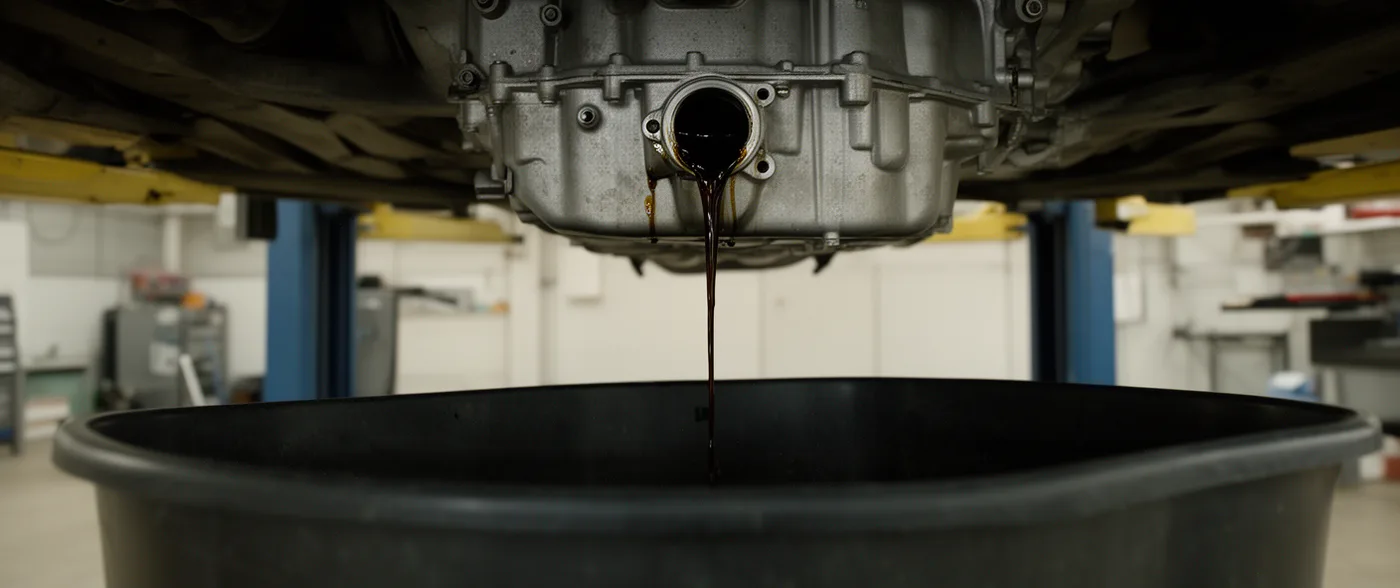
A habit that got mistaken for a specification
The number survives because it is easy to remember, easy to put on a windscreen sticker, and profitable for whoever puts it there. It is not printed in your manual unless your manual prints it. The only number that applies to your car is the one your manufacturer specified for your engine and your driving, and it is free to look up.
This page does not tell you your interval and cannot. Neither does CalRecycle, which states explicitly that it makes no recommendation for any specific make or model. The calculator takes your figure as an input; find it before you use it.
Check your own number
Your car may already know
Many cars since the mid-2000s carry an oil life monitor that computes an interval from how the engine has actually been run — cold starts, idling, load, temperature — rather than from distance alone. If your dash shows a percentage or an “oil life” readout, that is your number, and it already accounts for the “severe service” column that a shop might otherwise quote at you.
Two things still shorten it, and both are in the manual rather than in folklore: a lot of very short trips, where the oil never reaches temperature, and heavy towing. Neither is a reason to default to 3,000.
What it adds up to
CalRecycle’s reason for campaigning is not your wallet. In California alone, 115 million gallons of motor oil are sold a year, it is one of the largest categories of hazardous waste in the state, and 70 per cent is collected after use — which is the same statistic as saying that 30 per cent is not.
Their figure for what that means: one gallon of used motor oil can ruin a million gallons of water. Oil does not dissolve, and it carries heavy metals with it.
If you do change your own oil, the used-oil bit matters more than the new-oil bit. Most auto parts stores take used oil back free, and CalRecycle runs a directory of certified collection centres. Down a storm drain is the one disposal route with a measured consequence attached to it.
A number we refuse to quote
There is a widely circulated ranking of oil filters by ISO 4548-12 efficiency, and you will find it quoted confidently all over the internet, with figures from about 60 per cent to 99.96 per cent. We are not going to reprint it, for two reasons that are worth knowing whoever you read it from.
- The report is not public. The numbers circulate through enthusiast forums, describing testing commissioned privately. We could not obtain the laboratory report itself, and a figure we cannot read the conditions for is not a figure this site prints.
- The percentages are not always at the same particle size. An efficiency quoted at 35 µm and one quoted at 20 µm are answers to different questions, and the larger size is the easier exam. Ranking them against each other in one column produces a table that looks rigorous and is not.
What you can rely on: ISO 4548-12 is a real standard and a filter maker who publishes an efficiency with its micron size is making a checkable claim. One that prints a percentage with no particle size attached is not. That is the thing to look for on the box, and it is the same discipline as a torque wrench’s tolerance: the standard is what makes the number mean anything.
use it CalRecycle, California Department of Resources Recycling and Recovery, Check Your Number! 3,000 Miles May Be Too Early to Change Your Oil, read August 2026. A state agency's public campaign and its used-oil statistics: 115 million gallons of motor oil sold in California a year, one of the largest categories of hazardous waste in the state, of which 70 per cent is collected after use, and one gallon of used oil able to spoil a million gallons of water. The interval guidance is exactly that -- guidance to read your own owner's manual. CalRecycle states plainly that it makes no recommendation for any specific make or model, and neither do we.
not measured No independent laboratory comparison of engine oils or oil filters is cited here, because we could not obtain one whose conditions we could read. The interval arithmetic is division, and the interval itself has to come from your manual.