Parking mode, and the two words that decide it.
Parking mode is the feature people buy a dash cam for and the one most likely to be switched off, missing or useless when something happens. Two things decide whether it works: how the camera is powered, and whether the recording is buffered. Everything else on the listing is detail.
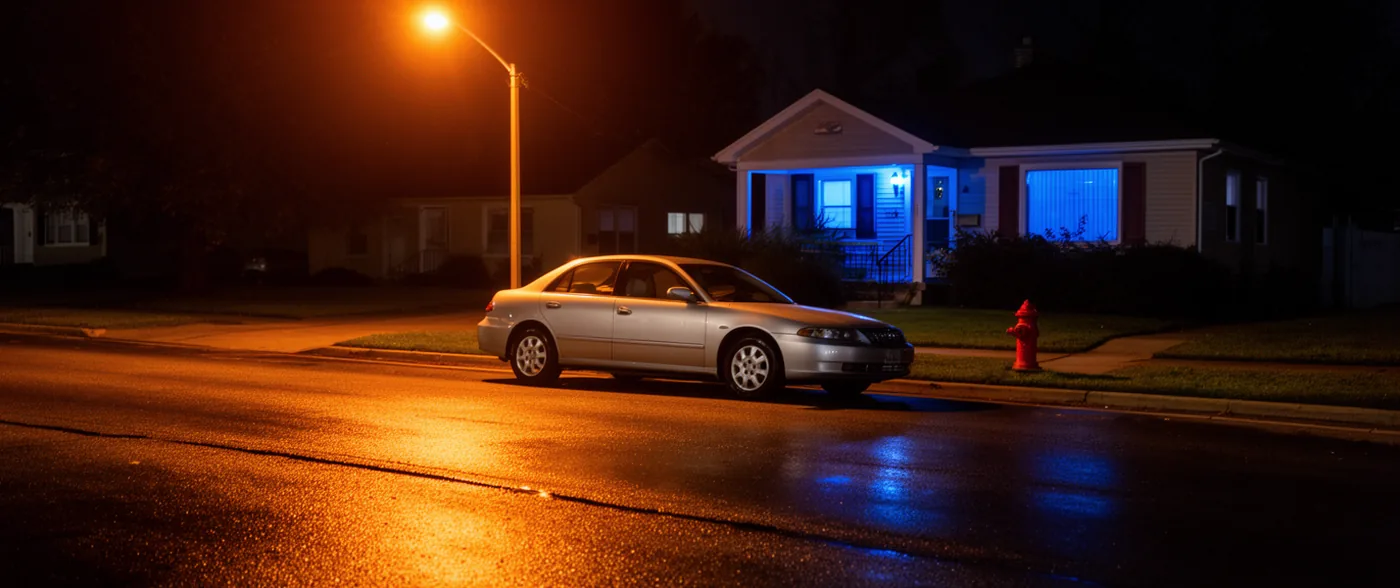
The part that stops people: power
In most cars the 12 V socket dies with the ignition. A dash cam plugged into it cannot watch anything while you are away, no matter what its box says, because it has no power. This is the single most common reason a parking mode never runs.
The fix is a hardwire kit into the fuse box, which takes permanent power and cuts off at a voltage you set so the camera stops before it strands you, or a separate battery pack that charges while you drive. Of the six cameras below, every one requires hardwiring or a battery pack for its full parking mode. None of them run it from the cigarette lighter. A battery left to sit at partial charge sulphates and loses capacity, so a parking mode that draws for days is spending something even when it never triggers.
Buffered or not, and why it decides everything
A camera in parking mode is either recording continuously into a rolling buffer, or it is asleep waiting for a trigger.
Buffered means the camera is always holding the last few seconds in memory, so when the impact fires the g-sensor it saves what happened before the hit as well as after. That is the footage that identifies the car that reversed into you.
Unbuffered means recording starts when the trigger fires. By then the wing mirror is already broken and the other car is often out of frame. You get the aftermath, which proves the damage happened and not who did it.
If a listing does not use the word “buffered” or state a pre-impact time, assume it does not have one. The feature is expensive to implement and manufacturers advertise it when they have it.
What six cameras claim
Every column here carries the manufacturer's mark. That is not a gap in our sourcing — we could not find a published measurement of any parking-mode behaviour anywhere. The buffer lengths below are what the makers say, reprinted by Car and Driver in its test.
| Product | Pre-impact buffer claimed marked | Power needed claimed marked | Storage ceiling claimed marked | Where to buy |
|---|---|---|---|---|
| 70mai T800 Front 4K, rear 4K, interior 1080p | Up to 3 min before, 30 s after | Hardwire for 24 h mode | 512 GB microSD | Check on Amazon |
| 70mai Omni X800 Rotating front camera, AI motion tracking | 10 s to 3 min before, 30 s after | Hardwire for 24 h mode | microSD, 32 GB included | |
| Vantrue N5S Four channels | 10 s before | Hardwire required | 1 TB microSD | Check on Amazon |
| Viofo A329S Automatic hybrid parking mode | Not stated | Hardwire kit or battery pack | 512 GB microSD, 4 TB via SSD | |
| Vantrue E1 Pro Front only | Buffered, length not stated | Hardwire for 24/7 modes | 1 TB microSD | Check on Amazon |
| Vantrue Pilot 2 Four parking modes | Not stated | Hardwire required | 1 TB microSD |
marked Car and Driver, Best Dash Cams for 2026, Tested and Reviewed, 31 July 2026. Parking-mode behaviour, buffer length, hardwiring requirement and storage limits as published by each manufacturer and reprinted in the test's spec tables. Car and Driver separately shoot a resolution chart and photograph a plate at 5, 10, 25 and 50 ft, but publish those as images rather than as distances.
The spread in the first column is the useful part. Vantrue's four-channel flagship claims 10 seconds of pre-impact footage; 70mai's T800 claims up to three minutes — eighteen times as much, on a cheaper camera. Three of the six do not state a figure at all, which on a feature this specific is itself informative.
Three of the six carry a link and three do not, and the reason is worth a sentence because it is the same reason this page has no measurements. A link here goes to one listing, so we only add one where the listing is unambiguous, and these could not be:
- 70mai Omni X800 — its listing title does not contain the model name.
- Viofo A329S — it is sold as a two-channel and a three-channel product under separate listings, and the test does not say which it used.
- Vantrue Pilot 2 — we found no Amazon listing for it.
Checked on Amazon on 12 August 2026, and worth re-checking: a listing can be relisted or withdrawn. Sending you to a plausible neighbour of the camera you read about is worse than sending you nowhere.
One observation worth carrying across from the test rather than the spec sheet: Car and Driver reported that the 70mai Omni's AI subject-tracking did not consistently pick up people moving around the vehicle, particularly outside bright daylight. That is their hands-on impression rather than a measurement, and we have not put it in the table for that reason — but a motion trigger that misses people in the dark is a parking mode that does not do its job.
Will it flatten the battery?
Honestly: we cannot tell you. A hardwire kit with a voltage cut-off is designed to prevent exactly this, and setting it conservatively is the standard advice. But we found no published measurement of what any of these cameras actually draws in parking mode, in milliamps, over a stated number of hours, at a stated temperature.
Without that figure nobody — including us — can tell you how many days your car can sit. Treat any site that gives you a confident number here as having made it up, unless it names the instrument.
What the cut-off number actually means
There is one number on this page you do control, and every guide tells you to set it “conservatively” without saying what conservative is. A hardwire kit stops drawing when the battery falls to a voltage you choose. Here is the scale that number is drawn on — and it is the only measured figure on this page.
- 12.6 V — full
- 12.4 V — about 75 per cent
- 12.2 V — about 50 per cent
- 12.0 V — about 25 per cent
- below roughly 11.8 V — effectively flat
Now the part that stops this being a prediction. Those are rested figures: open-circuit, several hours after the engine last ran. A hardwire kit reads a battery in neither condition — one that has recently been charged, and that is under a small continuous load from the camera it is powering. So the ladder tells you what a voltage means about a battery. It does not tell you what your kit will see at three in the morning, and nothing we have found measures that.
What it does settle is which way to err, because the two directions are not symmetric. Set the cut-off high and you lose the last hours of parking coverage — the camera stops while the battery still has plenty in it. Set it low and the failure is a car that will not start. One of those costs you footage of an empty car park at dawn; the other costs you the morning. That asymmetry is ours, not a measurement, and it is the whole reason the standard advice runs the way it does.
If you want to know where your own battery sits on that ladder, a meter across the terminals will tell you — but only under the condition the figures were taken in, which is rested: several hours after the engine last ran, and with the camera not drawing. Reading it overnight while parking mode is recording measures the battery under exactly the load that stops the ladder applying, which is the mistake this section spent two paragraphs warning about. Turn the camera off, or take the reading before you wire it in. What the voltage tells you when a car will not start works through the same figures from the other end.
What nobody has measured
- Current draw in parking mode, in mA, per camera, per mode.
- Wake latency. A camera that takes two seconds to wake has already missed the impact unless it is buffering. Only one maker in this group mentions wake time at all.
- Trigger reliability. How often the motion or g-sensor actually fires for a real event, and how often it fires for a lorry driving past.
- Heat. Parking mode runs in a closed car in summer. Nobody has published a thermal shutdown threshold.
Four questions, no published answers. Until somebody measures them, the honest advice is to buy on the buffer figure — which is at least stated — and to hardwire it properly.
use it Convergent, four independent sources, 12 V battery state-of-charge and cranking voltage, read 31 July 2026. The open-circuit voltage table for a 12 V lead-acid battery is not one publication's claim: four independent sources we read give the same figures to the tenth of a volt — 12.6 V rested is full, 12.4 V is about 75 per cent, 12.2 V about 50, 12.0 V about 25, and below roughly 11.8 V effectively flat. All four also give the same load threshold: a healthy battery does not fall below 9.6 V while the engine is cranking. Measure rested, meaning several hours after the engine last ran.
not measured No published test states what any of these cameras draws in parking mode, so the voltage ladder above is the state of a battery and not a prediction about a camera. Nothing here converts one into the other, because nothing we have read measures the step between them.